

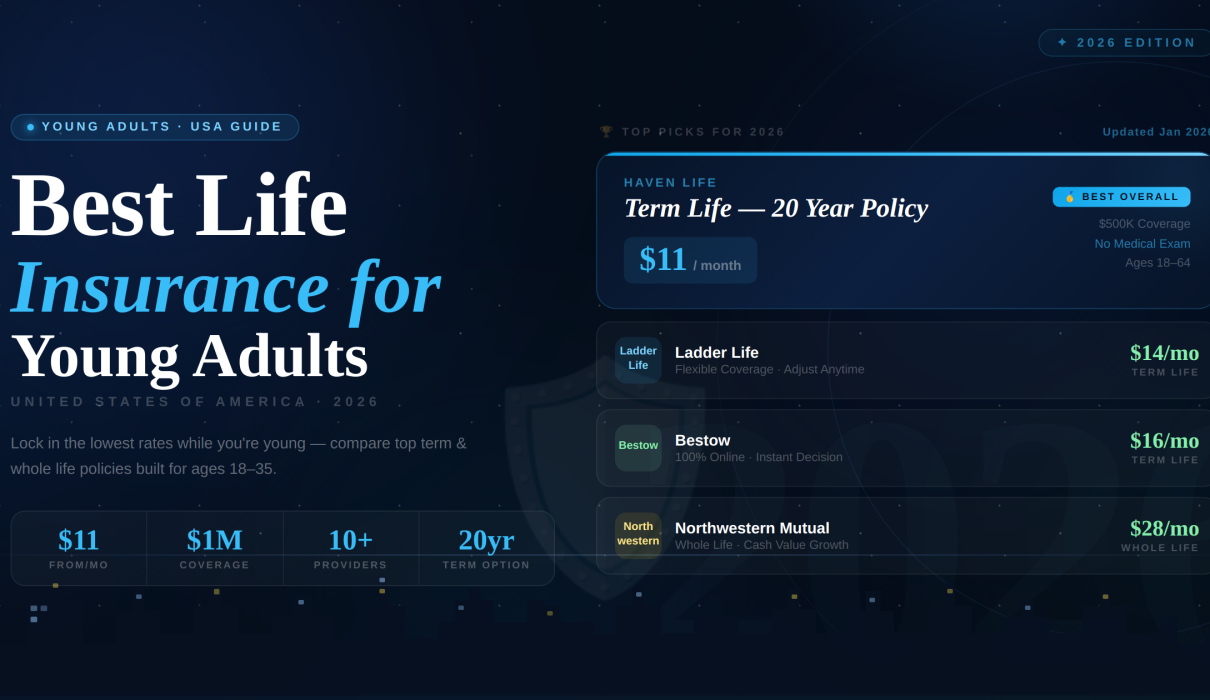
If you are in your 20s or early 30s, life insurance probably feels like a problem for future-you. You are healthy, you are building your career, and the idea of sitting down with an insurance agent sounds about as fun as filing taxes. But after more than five decades of watching families navigate financial hardship, I can tell you this with certainty: the best time to buy life insurance for young adults is right now, before life gets complicated and premiums get expensive.
In 2026, a healthy 25-year-old non-smoker can get $500,000 in term life coverage for as little as $18 to $25 per month. That is less than most streaming subscriptions combined. Wait a decade, add a health condition, a mortgage, and two kids, and that same policy could cost two or three times as much — or become harder to qualify for. This guide breaks down your best options, what they actually cost, which companies lead the market in 2026, and how to make the right call for your situation.
| ⚡ Quick Takeaway Term life insurance is almost always the smartest, most affordable choice for life insurance for young adults. A 20-year, $500,000 policy can cost less than $1 per day for a healthy person in their mid-20s. |
Why Life Insurance for Young Adults Makes Sense in 2026
Most young Americans assume life insurance is only necessary once you have dependents. That thinking is understandable — and expensive. Here is why acting early is one of the highest-return financial decisions you can make:
- You lock in the lowest rates you will ever qualify for — age and health are your two biggest pricing variables
- Private student loan co-signers (parents, relatives) remain liable if you die — federal loans are discharged, but private ones often are not
- A spouse, partner, or elderly parent depending on your income needs protection today, not eventually
- If you recently bought a home, your co-borrower inherits a mortgage they may not be able to carry alone
- Employer life insurance typically covers only 1–2x your salary, is not portable, and disappears if you change jobs
- A policy bought at 24 covering you for 20 years runs until you are 44 — through your peak earning, family-building, and mortgage years
The math is straightforward. A 25-year-old buying a $500,000, 20-year term policy pays roughly $18–$25 per month. Delay that decision by 10 years and the same policy costs $45–$70 per month. That difference, invested over the same 20 years at a 7% average return, is real money — thousands of dollars in lost compounding.
Types of Life Insurance for Young Adults — Know Before You Buy
The life insurance market offers several product types. Understanding each one takes about five minutes and can save you from buying the wrong product entirely.
| Type | Coverage | Avg Monthly Cost (25yo) | Cash Value? | Best For |
| Term Life (20-yr) | $250K–$1M | $16–$28 | No | Most young adults |
| Term Life (30-yr) | $250K–$1M | $22–$40 | No | Long-term mortgage coverage |
| Whole Life | $50K–$500K | $100–$350+ | Yes | Lifelong needs, special dependents |
| Universal Life | $100K–$1M | $80–$260+ | Yes (flexible) | Flexible premium payers |
| Final Expense | $10K–$25K | $30–$60 | No | Burial cost coverage only |
* Approximate monthly premiums for a healthy non-smoker. Actual rates vary by insurer, state, and health classification.
Term Life Insurance — The Right Answer for Most Young Adults
Term life is simple: you choose a coverage amount and a term length (10, 15, 20, or 30 years), pay a fixed premium every month, and your beneficiaries receive the death benefit if you pass away during the term. No investment component, no complexity, no surprises. And for a young, healthy person, the premiums are genuinely low.
A 20-year term is the sweet spot for most people in their 20s. It covers you through the years when financial obligations — mortgages, raising children, building retirement savings — are at their highest. Once the term ends, your kids are likely grown and your debts largely paid down. If you want to keep options open, a 30-year term bought at 25 runs until 55, covering you through your entire peak financial responsibility window.
Whole Life Insurance — When It Is Actually Worth Considering
Whole life costs 10–15x more than term for the same death benefit. That premium buys you permanent coverage that never expires and a cash value component that grows at a guaranteed rate. For the vast majority of young adults, that trade-off does not pencil out. The cases where whole life makes sense are specific: you have a lifelong dependent (a child with a disability), you are a high-net-worth individual with complex estate planning needs, or you have maxed out every other tax-advantaged account and want additional sheltered growth. Otherwise, buy term.
Universal Life — Powerful but Frequently Oversold
Universal life offers adjustable premiums and death benefits with a cash value component tied to interest rates or market indexes. These are sophisticated products that can serve a real purpose in the right hands — and are routinely oversold to people who would be better served by a straightforward 20-year term policy. If an insurance agent is pushing UL products heavily on a first meeting with a 26-year-old, that is a signal to get a second opinion from a fee-only fiduciary advisor.
Best Life Insurance Companies for Young Adults in 2026
Financial strength, pricing, ease of application, and policy flexibility are the four variables that matter most. Here are the providers I would send any young adult to in 2026:
| Provider | Best For | A.M. Best Rating | ~Monthly Cost (25yo, $500K Term) |
| Haven Life | Online / fast decision | A+ | $22–$30 |
| Banner Life | Lowest term rates | A+ | $18–$26 |
| Protective Life | Long-term term policies | A+ | $19–$28 |
| Pacific Life | Universal / IUL products | A+ | $175–$265 |
| MassMutual | Whole life / dividends | A++ | $280–$355 |
| Ladder Life | Flexible / adjustable coverage | A (reinsured) | $20–$29 |
| Ethos Life | No-exam, fast approval | A+ | $23–$34 |
Haven Life — Best for Digital-First Applicants
Backed by MassMutual (A++ rated), Haven Life offers a fully online application with instant or near-instant decisions for healthy applicants. Coverage up to $3 million, terms from 10 to 30 years. If you want to get covered in under an hour without leaving your couch, start here.
Banner Life — Best Pure Rate Competition
If your primary goal is the lowest possible monthly premium, Banner Life consistently ranks at or near the top of term rate comparisons for people in their 20s and 30s. They offer terms up to 40 years, which is ideal if you are 25 and want coverage until 65 without ever reapplying.
Ethos Life — Best No-Exam Option
Ethos has built a streamlined, no-paramedical-exam process that can get many healthy young applicants covered quickly. Rates run slightly higher than fully underwritten policies, but if you want speed and simplicity with a clean health history, Ethos delivers.
MassMutual — Best for Whole Life
If whole life is genuinely appropriate for your situation, MassMutual is the gold standard. They have paid dividends to policyholders for over 160 consecutive years. The premiums are not cheap, but the long-term track record justifies the brand for those who need permanent coverage.
How Much Coverage Do You Actually Need?
The standard rule of thumb is 10–12x your annual income. That is a reasonable starting point, but a more precise calculation looks at four numbers:
- Total outstanding debts (student loans, mortgage, car loan, credit cards)
- Annual income that dependents rely on, multiplied by years until financial independence
- Future expenses you want covered (children’s education, spouse’s retirement)
- Final expenses — funeral costs average $8,000–$12,000 in the USA in 2026
Add those four figures together and you have your minimum coverage floor. For a 28-year-old earning $70,000 with $45,000 in student debt, a spouse, and plans to have children, a $750,000 to $1 million 20-year term policy is a rational and still very affordable target.
| Expert Insight Never rely solely on employer-provided group life insurance. It typically covers only 1–2x your annual salary — far below what most families need. It is also non-portable, meaning you lose it the moment you change jobs. Own your own policy regardless of what your employer offers. |
What Does Life Insurance for Young Adults Actually Cost in 2026?
Rates are determined by your age, gender (women typically pay 20–30% less), health classification, tobacco use, coverage amount, and term length. The table below shows real-world approximate monthly premiums for a healthy non-smoking applicant:
| Age | $250K / 20-yr Term | $500K / 20-yr Term | $1M / 20-yr Term |
| 22 | $10–$14 | $16–$22 | $28–$38 |
| 25 | $11–$16 | $18–$26 | $30–$42 |
| 28 | $12–$18 | $20–$30 | $34–$50 |
| 30 | $14–$20 | $22–$34 | $38–$58 |
| 35 | $18–$28 | $30–$50 | $54–$90 |
* Monthly estimates for healthy non-smokers, 2026. Get personalized quotes from at least three insurers before deciding.
The single most powerful pricing lever available to you is your age. Every year you wait costs money — not just in higher premiums, but in the increased risk that a health event changes your underwriting classification or makes you uninsurable. Acting at 24 versus 34 on a $500,000, 20-year policy can save you $3,000 to $5,000 over the life of the policy for a healthy individual.
Term vs. Whole Life Insurance — The Honest Math
This comparison fills thousands of insurance marketing pages. Let me cut through it cleanly:
| The Math That Matters A 25-year-old buying $500,000 whole life might pay $290/month. The same $500K on a 20-year term costs $22/month. That difference is $268/month. Invested in a low-cost index fund averaging 7% annually over 20 years, that equals approximately $165,000 in additional wealth. ‘Buy term, invest the difference’ is not a slogan — it is arithmetic. |
The only honest counterarguments for whole life at a young age are highly specific: a lifelong dependent requiring permanent protection, complex estate tax planning for high-net-worth individuals, or a business ownership arrangement requiring a permanent policy. For standard wealth-building young adults in their 20s and early 30s, term life insurance wins every time.
The same principle applies across personal finance categories. Just as the cheapest car insurance for young drivers is found by comparing multiple carriers and buying only what you need — not the most expensive policy with maximum add-ons — the right life insurance strategy is about precision, not premium size.
How to Buy Life Insurance as a Young Adult — Step by Step
- Calculate your coverage need: income replacement + debts + future expenses + final costs
- Choose your term length — 20 years for most people; 30 years if you have a new mortgage or are in your early 20s
- Get quotes from at least 3–5 insurers — use an independent broker or a comparison platform
- Apply honestly — misrepresentation on your application can void your death benefit when your family needs it most
- Complete any required medical exam — many top providers now offer no-exam options up to $1–2 million
- Review your policy documents carefully: confirm coverage amount, beneficiaries, exclusions, and whether a conversion option is included
- Set up automatic premium payments — a lapsed policy means zero coverage, and you may not qualify for a new one at the same rate
| Pro Tip: Always Look for a Conversion Option A conversion rider allows you to convert your term policy to permanent coverage later, without a new medical exam. If your health changes during the term, this option is invaluable. Always ask about it before signing. |
5 Mistakes Young Adults Make When Buying Life Insurance
- Waiting — every year of delay raises your premiums and increases the risk of an uninsurable health event
- Underinsuring — saving $6/month by choosing $250K instead of $500K leaves your family catastrophically exposed
- Relying on employer coverage — it is inadequate, non-portable, and disappears when your job does
- Buying whole life they do not need — paying 10–15x more than necessary without a genuine permanent-coverage need
- Forgetting to update beneficiaries — after marriage, divorce, or the birth of a child, an outdated beneficiary designation can send the payout to the wrong person
Build Your Complete Financial Protection Plan
Life insurance is one cornerstone of a sound financial protection strategy. To build a complete picture, explore our full range of insurance guides at USAFinanceLab — covering everything from renters insurance to health coverage for the self-employed, term vs. whole life comparisons, and pet insurance. Each guide follows the same principle: compare the market, buy only what you need, and act early enough to capture the best rates available.
Frequently Asked Questions — Life Insurance for Young Adults
At what age should young adults buy life insurance?
The earlier the better. A policy purchased at 22–25 locks in the lowest premiums you will ever see. That said, any time in your 20s or early 30s is an excellent window. Every year of delay costs money and adds risk.
Is life insurance worth it if I am single with no dependents?
Yes, in most cases. Even without current dependents, a term policy bought today protects you through future marriage, homeownership, and children — all at your current low rate. It is one of the few products where procrastinating is mathematically provable as expensive.
Can I get life insurance if I have student loan debt?
Yes. Student loan debt does not affect your ability to qualify. However, if a parent or family member co-signed your private student loans, they remain liable if you die. Life insurance directly protects them.
What is the best life insurance company for a 25-year-old?
Haven Life, Banner Life, and Ethos consistently score highest for young adults in 2026 based on pricing, financial strength ratings, and application experience. Always compare at least three direct quotes before committing.
Do I need a medical exam to get life insurance?
Not always. Ethos, Haven Life, and Ladder offer no-exam or accelerated underwriting for healthy applicants up to $1–$2 million in coverage. Fully underwritten policies (with a medical exam) typically offer slightly lower premiums if your health is excellent.
Bottom Line — Best Life Insurance for Young Adults in 2026
After more than five decades of financial planning, my advice has not changed: the best life insurance for young adults is the one you actually purchase today, not the perfect policy you research indefinitely. Start with a 20-year term policy, target $500,000 to $1 million in coverage based on your real obligations, and lock in your rate while youth and health are working in your favor.
Get quotes from Banner Life, Haven Life, and Ethos. Compare them on equal footing — same coverage amount, same term length. Choose the one with a conversion option. Name your beneficiaries carefully and set up autopay. Then take the premium difference between term and whole life and direct it into a Roth IRA or index fund. That combination is the formula that builds real, lasting wealth. For every other layer of your financial protection plan, browse our insurance resource center at USAFinanceLab — and make sure every major financial risk in your life is covered before the cost of covering it goes up.
| ⚠️Disclaimer This article is for informational and educational purposes only. It does not constitute financial, legal, or insurance advice. Premiums and policy features vary by insurer, state, and individual health profile. Always consult a licensed insurance professional before purchasing a policy. |